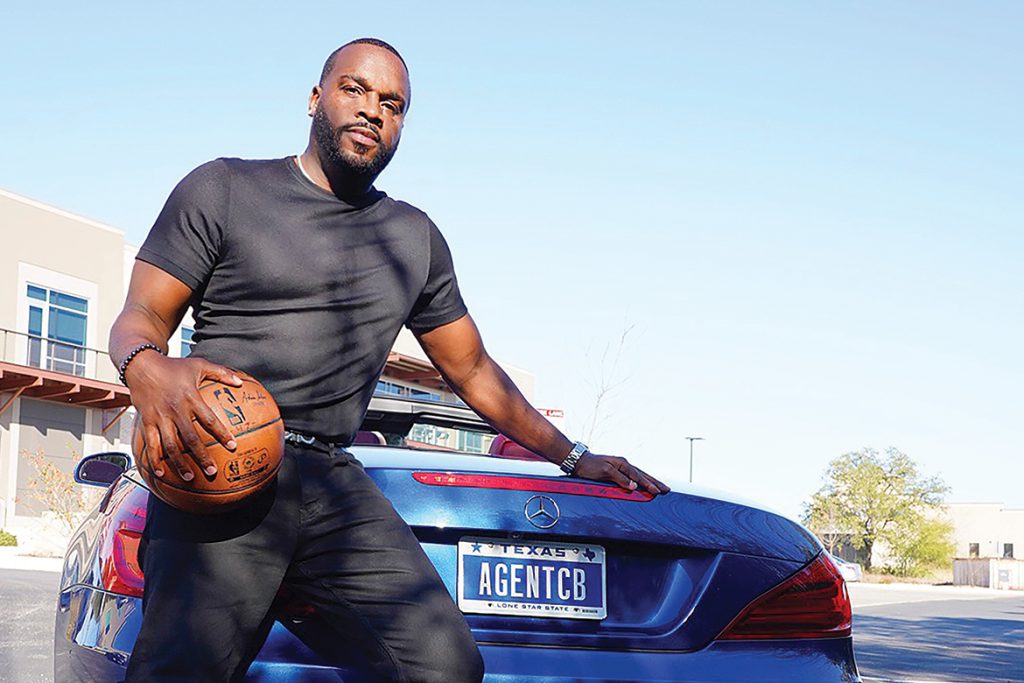
 Colin Bryant ’15
Sometimes dreams change. For alumnus Colin Bryant, his dreams of a pro basketball career were dashed by an injury. But now Bryant is a highly successful sports agent and executive, who not only helps college basketball players go on to play professionally, he also prepares them for life.
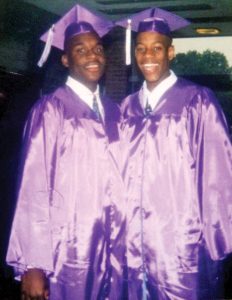
Helping young people succeed is Bryant’s mission in his career and in his life. Bryant earned his Master of Business Administration degree with a specialization in sport business in 2015, fulfilling a promise to his parents. He left college as an undergraduate to help his friend, NBA broadcaster and former player Antonio Daniels, when Daniels was drafted by the then-Vancouver Grizzlies. With that experience, he became a certified sports agent, but he also completed his degrees.
Bryant and Daniels were childhood friends growing up in Columbus, Ohio, playing basketball at St. Francis DeSales High School, a Catholic school in Columbus. “Growing up in Columbus, Antonio was my best friend,” Bryant said. “We played all the time with dreams of going to the NBA. We were on track for our dreams to come true.”
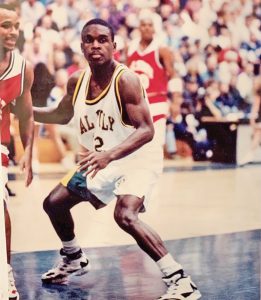
Both skilled players, Daniels earned a scholarship to Bowling Green State University in Ohio, while Bryant earned a full-ride basketball scholarship to California Polytechnic State University, San Luis Obispo. But Bryant’s dream was derailed by a hip injury and a broken jaw his senior year at Cal Poly. “At the time, I was maybe a year shy of getting my degree,” he said.
Instead, Daniels was selected by the Vancouver Grizzlies with the fourth overall pick of the 1997 NBA draft. It was for Bryant, the “opportunity of a lifetime to help him. He wanted me to come.”
Daniels, now the color analyst for the New Orleans Pelicans, said he has been through “heaven and hell” with Bryant. “The Lord has blessed us to evolve together inside each other’s lives,” Daniels said.
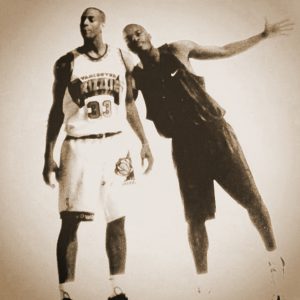
Bryant dropped out of Cal Poly and moved to Vancouver, British Columbia, accompanying his friend. “He signed a three-year, $8 million contract,” Bryant said of Daniels. “We were 22 years old, and off to fend for ourselves.”
While Daniels had one of the top sports agents at the time, he did not receive attention, and Bryant took over that role. He began marketing Daniels, and thought, “‘this could be something that I could do.’”
By end of the rookie year, Daniels was traded to the San Antonio Spurs in Texas. “That was a blessing in disguise for both of us,” Bryant said. “He went from the worst team in the league to winning the 1999 NBA championship.”
Bryant learned the business of the NBA from Spurs management and players, including Gregg Popovich, R.C. Buford, David Robinson, and Tim Duncan, and he eventually was certified as an NBA agent.
But Bryant never forgot the promise he made to his mother and father about completing his degree. He said, “Although I was practicing in the industry, I made it a priority to pursue my education.”
He enrolled at the University of Texas-San Antonio and completed a semester. Then Daniels was traded to the Portland Trailblazers. Due to the rigors of his career and travel schedule, it was impossible to be in the classroom, so Bryant decided to focus on his blossoming career. During this time, he signed more players, including Raymond Felton, Damian Wilkins, Acie Law, and his biggest client Rashard Lewis, whom he negotiated a $100 million-plus deal with the Orlando Magic.
“But through it all, that promise I made and the desire to get a degree was always on my mind. I felt empty,” Bryant said. “Although, I was achieving at a high level, I knew I could do so much more.”
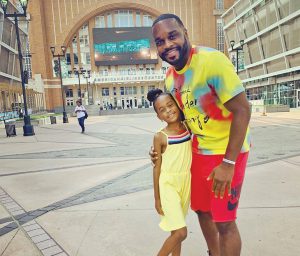
In 2011 he was inspired by the birth of his daughter Bella. “I took my role as a father seriously,” he said. “I didn’t want to be a hypocrite and push education when I hadn’t completed my degree. I wanted to be someone she could look up to.”
As online education became more prevalent, Bryant completed his degree in management from the University of Phoenix. “But I had a thirst for more knowledge,” Bryant said. “I became more comfortable with online learning and better appreciated the value in the convenience that it afforded me. I had the hands-on experience [as a sports agent], but I wanted to add technical knowledge, case studies, and I was looking for the best school to attend.” He was impressed by Saint Leo’s curriculum, and the enrollment process was easy, but it was a busy time in his career and life.
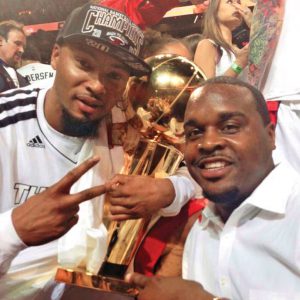
At the time, Lewis was playing for the Miami Heat with Lebron James, Dwayne Wade, and Chris Bosh. “I was studying on airplanes, in hotels, after games, and anywhere I could,” Bryant said of his Saint Leo studies. “I was a young father with a lot of responsibility, but I was committed to my studies at Saint Leo. I had late nights and early mornings. But I also had the support from my teachers and classmates. It was the community that I needed to fulfill my dreams.”
Bryant understood that earning his MBA with a sport business specialization was a way to sharpen his blade, add skills, and meet personal goals. “It makes me more efficient as an agent, a businessman, and an entrepreneur,” he said.
He completed his last 40-page paper after attending the NBA draft, rushing back to his hotel to finish it. “I earned this degree!” he said. “I have achieved a lot, but this was one achievement that I hold close to my heart and that brings me a strong sense of pride. I framed my degree right away.”
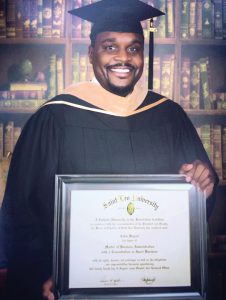
Bryant said Saint Leo improved his skills in communicating online with people around the world and working with others in business settings. “It was preparing me for pandemic life, five years later,” he said with a laugh. “I was connecting with people all over the world. I’m glad I got a chance to do it later in life and appreciate the information I learned. It helped to further develop my 40-year-old executive mindset.”
Daniels said Bryant’s greatest attributes are his work ethic and attitude. “Even though things have not always gone his way, he has not stopped working,” the NBA broadcaster said. “Most people would quit. He has bent, but he has never broken.”

Now, Bryant is the president of Max Deal Sports, a full-service sports management firm in Houston, Texas. In his role, he helps players navigate the world of professional basketball, preparing them for futures on and off the court. He talks to players and tells them it’s never too late to complete their degrees. “Basketball has an expiration date,” Bryant said. “You have to prepare for life after.”
He cites some of the players he represents, who have earned their degrees including Aric Holman (Mississippi State), Jordan Bone (Tennessee), and Jordan Bowden (Tennessee). He also represents Simi Shittu, who left Vanderbilt University after his freshmen year and is in the process of finishing his degree while playing professional basketball in Israel.
He gives back to the community by coaching Bella’s team and hosting a summer youth basketball camp with Daniels.
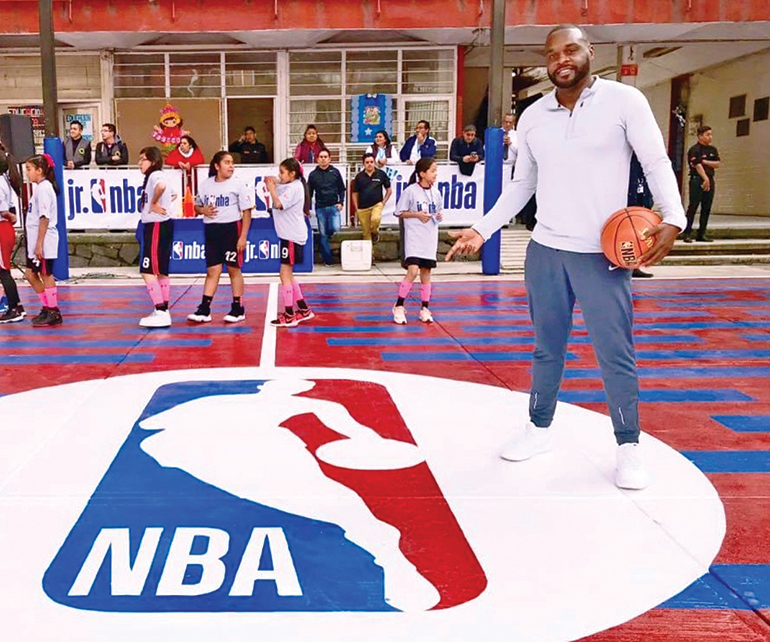
Bryant gives back to his community and focuses on the next generation by coaching his daughter’s sports teams, operating a youth basketball camp that he and Daniels created in San Antonio 20 years ago, and he is establishing a foundation to help urban city youth understand the importance of education while pursuing athletics.


 “This new 9,000-square-foot facility will provide more space for student resources, classes, and activities, better technology, and space to grow,” said Candis Whitfield, assistant vice president for the Central Region.


 The characters are depicted with Cordero’s positive and playful style: diverse children in fun, colorful outfits with large, emotion-filled eyes. Book two, for children ages 8 to 11, features the characters as superheroes who use their disability to cure and help others.
 The coloring books are self-produced at this time, and Cordero founded a nonprofit organization, Cyn’s Vision, to help with production and other efforts. Money raised from purchases go back to the project so that the books may be donated to children’s hospitals and individuals, she said.
 Historical research by Dr. Karen Hannel of the College of Arts and Sciences and her husband, Dr. Eric Hannel, an adjunct instructor with Saint Leo, prompted the state of Florida to approve the placement of an official marker to note that a vibrant township once existed north of University Campus in the 1800s. The town of Chipco was a trading post established by white settlers and was named for a Seminole chief who actually lived nearby, but separately, with some members of his tribe for a time after the mid-1850s. The white town grew to have a nearby railway link, lumber-planing mill, grist mill, school, and post office, along with farms. The Pasco County (FL) town reached the peak of its commercial prominence in the 1880s, but disappeared by 1909 after a series of economic reversals. Chief Chipco and his band had long since moved to a different locale in mid-Florida, and the chief died in 1881 at more than 100 years of age, according to a newspaper account. The Hannels continue to research this settlement, as its trajectory illustrates so much about the racial interactions, intermittent wars, and economic developments of 19th-century Florida.
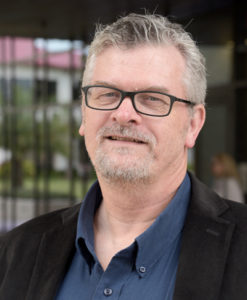 Dr. Iain Duffy, a microbiologist and member of the science faculty at University Campus, is president of the Florida Academy of Sciences and is now in the second year of a two-year term. The academy is comprised of scholars from the life sciences, physical sciences, social sciences, computer and mathematical sciences, and science teaching, and publishes a quarterly journal.
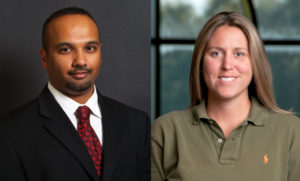 Dr. Leon Mohan and Dr. Deneˊ Williamson of the Tapia College of Business were published in late 2019 in the International Journal of Sport, Exercise and Physical Education with their article “Youth Sport Participation as a Result of Social Identity Theory.” The article describes survey research conducted in a South Florida city with youths involved with sports through various community organizations. In particular, the researchers zeroed in on children ages 9 to 13, who were primarily African American and Hispanic, to see what role social factors played in getting and keeping the youths involved in sports. The short-term objective was to help associations find influences that can be maintained to get and keep children physically active. Sports that parents and guardians were familiar with, sports played by famous athletes, and sports played by friends and peers were motivating influences. The business professors included work by undergraduate student John-Paul West in their research and publication.
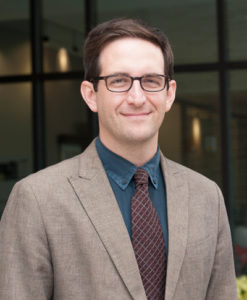 Dr. Matthew Tapie, theology faculty member and director of the Saint Leo University Center for Catholic-Jewish Studies, was invited in February by Spring Hill College in Alabama to deliver a talk on a particularly difficult point in Catholic and Jewish relations. Since 2018, Tapie has been speaking in academic settings and published in academic theological journals on the new controversy about the forced religious conversion of a young boy named Edgardo Mortaro in Bologna, Italy, in 1858. The child was being raised by a Jewish family, in accordance with their own faith, when the Catholic Church learned the boy secretly had been given a Catholic baptism when he was an infant and facing illness. A maid employed by the family performed the baptism without permission from or the knowledge of the baby’s parents. The woman presumably was leaning on her own Catholic teaching as motivation and feared for the soul of the baby if he did not recover. The boy was forcibly removed from his home on the order of Pope Pius IX when the Church eventually learned of this, and despite an international scandal, the church never backed down and instead raised the child.
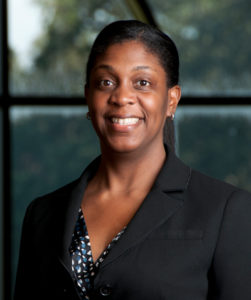 Dr. Moneque Walker-Pickett, professor and associate chair of the undergraduate criminal justice program, was selected for a prestigious fellowship program in higher education. She is one of only 38 professionals to be included in the 2020-2021 American Council on Education Fellows Program. The objective of the program is to provide learning opportunities that condense years of practical higher education experience into a curriculum of a single year. Fellows receive strategic planning training, make numerous visits to other campuses, and take part in interactive sessions. Upon completion of the program, fellows return to their own campuses better equipped to address evolving challenges in higher education. Walker-Pickett joins a diverse fellowship class comprised of individuals from Georgetown University, Purdue University, the U.S. Air Force Academy, among other institutions. In addition to holding a doctorate in sociology, Walker-Pickett holds a law degree and worked previously as an attorney. She became a full-time member of the Saint Leo University faculty at University Campus in August 2012.
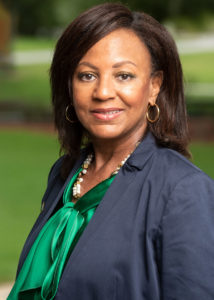 Prior to Saint Leo, Willis was the vice chancellor of university advancement and executive officer of the foundation at the University of North Carolina in Asheville. There, she launched and led a comprehensive giving campaign that raised more than $7.4 million, exceeding the university’s goal. Willis has held several advancement leadership roles throughout her career, which include Kean University in Union, NJ; Ohio State University; Florida A&M University; University of Toledo (OH); and University of Michigan. Willis received her Bachelor of Arts degree in interdisciplinary studies from the University of Toledo.
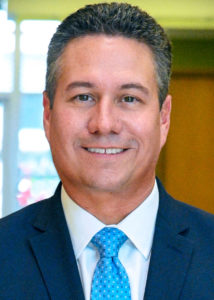 Mills comes to Saint Leo from South University (GA) where he successfully served as vice president of admissions for 11 campuses for more than a decade. He also was able to support the effective launch of eight new campus locations. Prior to South University, Mills served in admissions leadership positions at MedVance Institute of Fort Lauderdale (FL) and Career Education Corporation (IL). Mills received his bachelor’s degree in psychology from East Carolina University.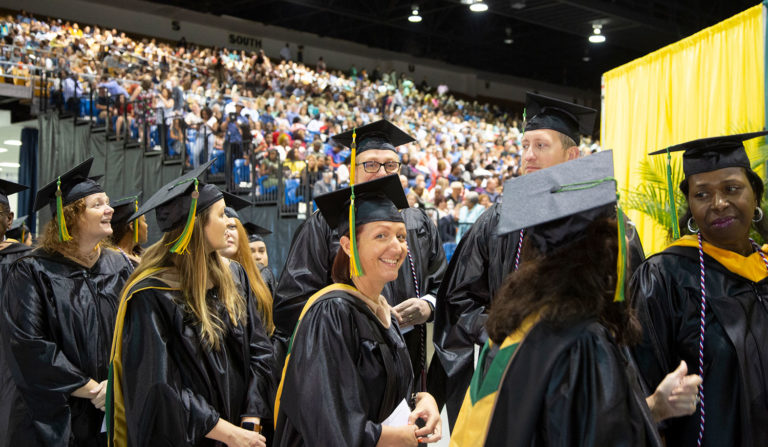
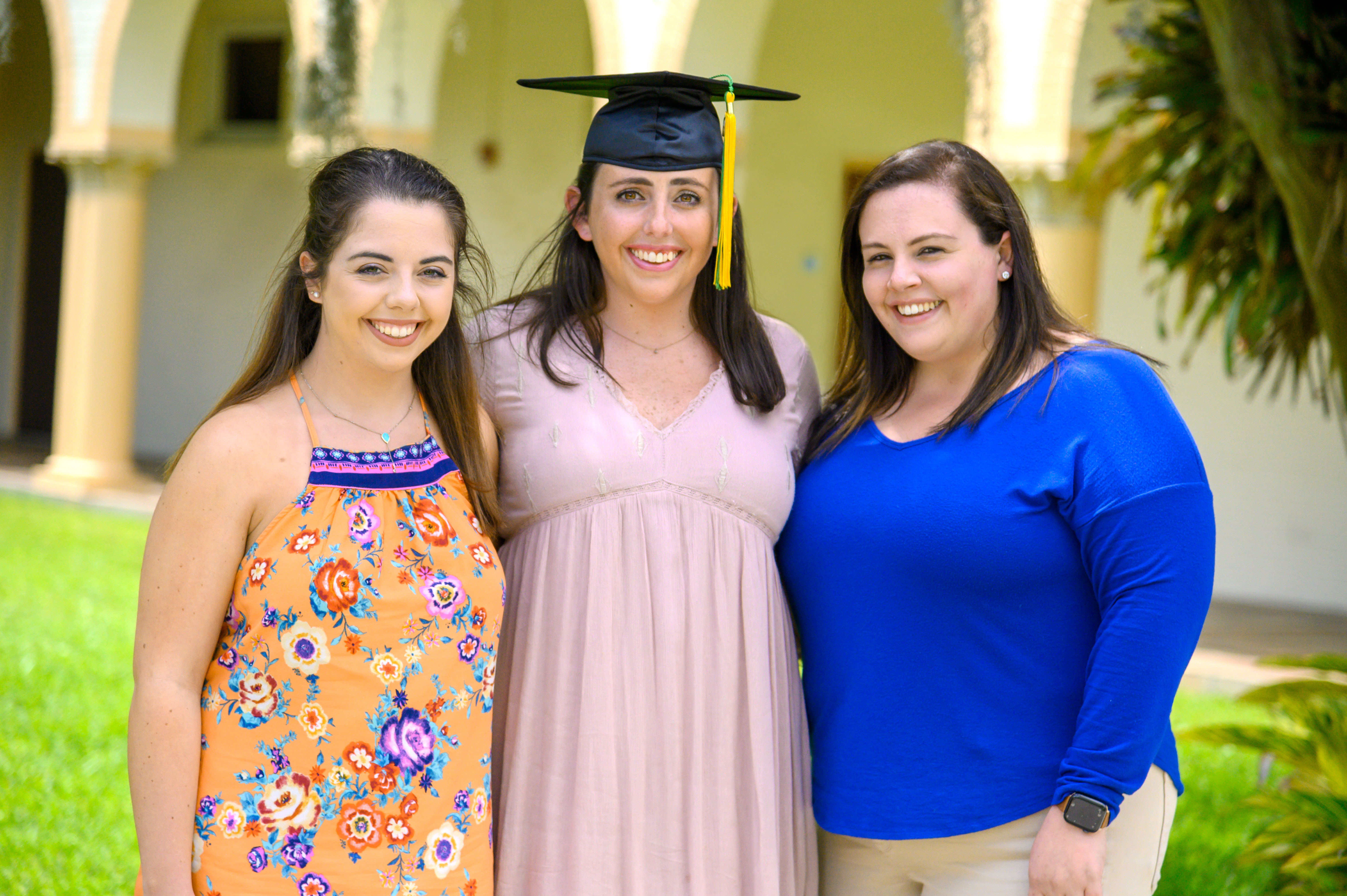
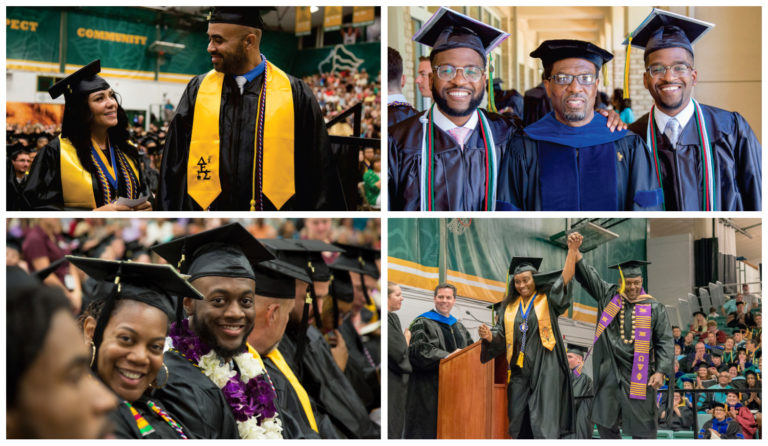
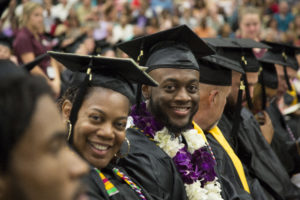
 Two recent grads from the Class of 2018 are not only twins, but they also graduated with the same major and held equivalent jobs as residence hall advisors. In another family connection, they are the sons of Sandy and Dr. Okey Igbonagwam, a Saint Leo assistant professor of computer information systems in Virginia.
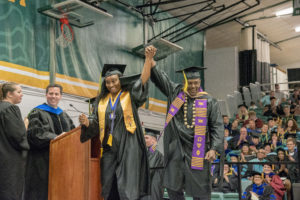 When Sherryl Johnson-Tandy and her husband Erik Tandy walked across the commencement stage together on the evening of Friday, April 27, it was a little out of the ordinary. Sherryl, a corporal in the Pasco County (FL) Sheriff’s Office, completed her Bachelor of Arts degree in criminal justice. So she was grouped with the other adult learners receiving undergraduate degrees in the evening.


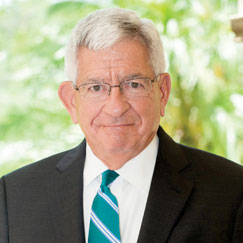 Bob Quinn